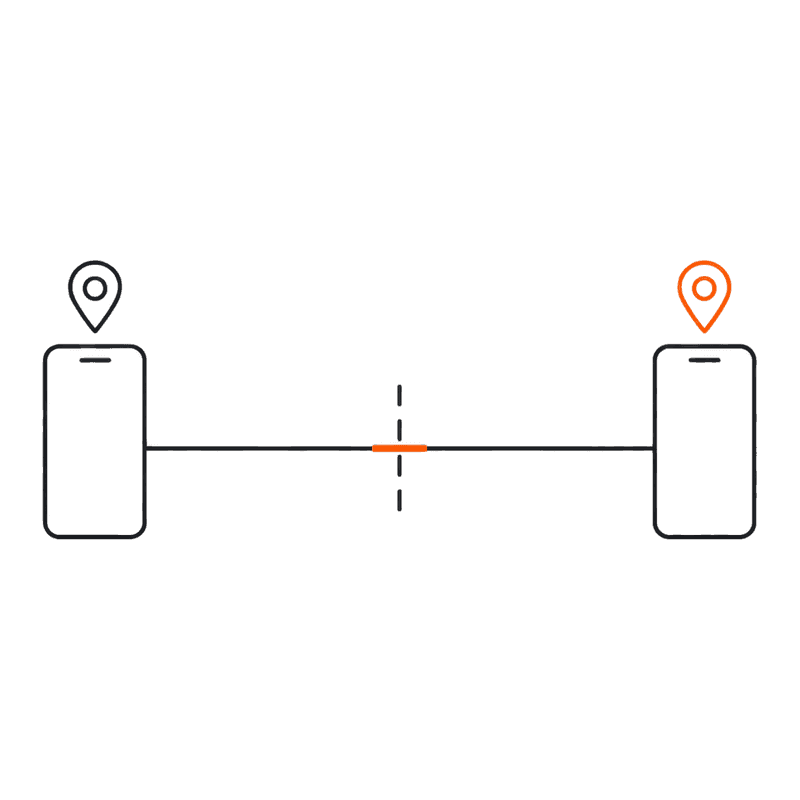
They are our own hardware: modems and phones we run, each with its own SIM on the carrier you choose at checkout. The address you get is the one that carrier assigns to that SIM, and for the month it is assigned to your account and nobody else’s — one modem, one customer. Nothing is borrowed from a stranger’s phone and nothing is a pool, so the question that hangs over residential proxies — whose device does this traffic leave from? — does not arise here.
Rotation is a reconnect. The modem drops and re-registers, and the carrier — the same carrier, never a different one — hands it a new address. If a modem fails, your proxy is moved to another modem on the same carrier within seconds; the address changes, because it belongs to the SIM’s session with the carrier, not to you. The cities and carriers below are what you are actually buying, so we publish them; we do not publish how many devices we run.
- HARDWARE
- Our own modems and phones, each with its own SIM on the carrier you choose.
- ONE MODEM, ONE CUSTOMER
- A dedicated device for the month. Not shared, not a pool.
- ROTATION
- Reconnect on demand; a new address from the same carrier every time.
- IF A MODEM FAILS
- Moved to another modem on the same carrier within seconds. The address changes.
Dedicated mobile proxy locations and carriers by country, as on the order form on 18 September 2026| Country | Cities and regions | Carriers |
|---|
| United States | New York · New Jersey · Boston · Massachusetts / Rhode Island · Pennsylvania · Virginia · North Carolina / Georgia · Florida · Houston · Chicago · Phoenix · California · California / Nevada | Verizon, AT&T, T-Mobile |
|---|
| France | Nice · Strasbourg | Orange, SFR, Bouygues Telecom, Free Mobile |
|---|
As on the order form. Not every carrier is available in every city, and some locations are phones rather than modems — the form marks them. Choose the city and carrier at checkout. Read from the order form on 18 September 2026.